Boris on 20 Years of Pink: "For Us, Heavy Means Sound That Is Real"

If you’ve ever been in the same room as Boris, you’ll know that their music is so loud that it can shake your skeleton. Formed in Japan in 1992, the band — consisting of drummer Atsuo, guitarist and bassist Takeshi, and guitarist and keyboardist Wata — has spent more than three decades creating music that cannot be separated from the physical experience of hearing it.
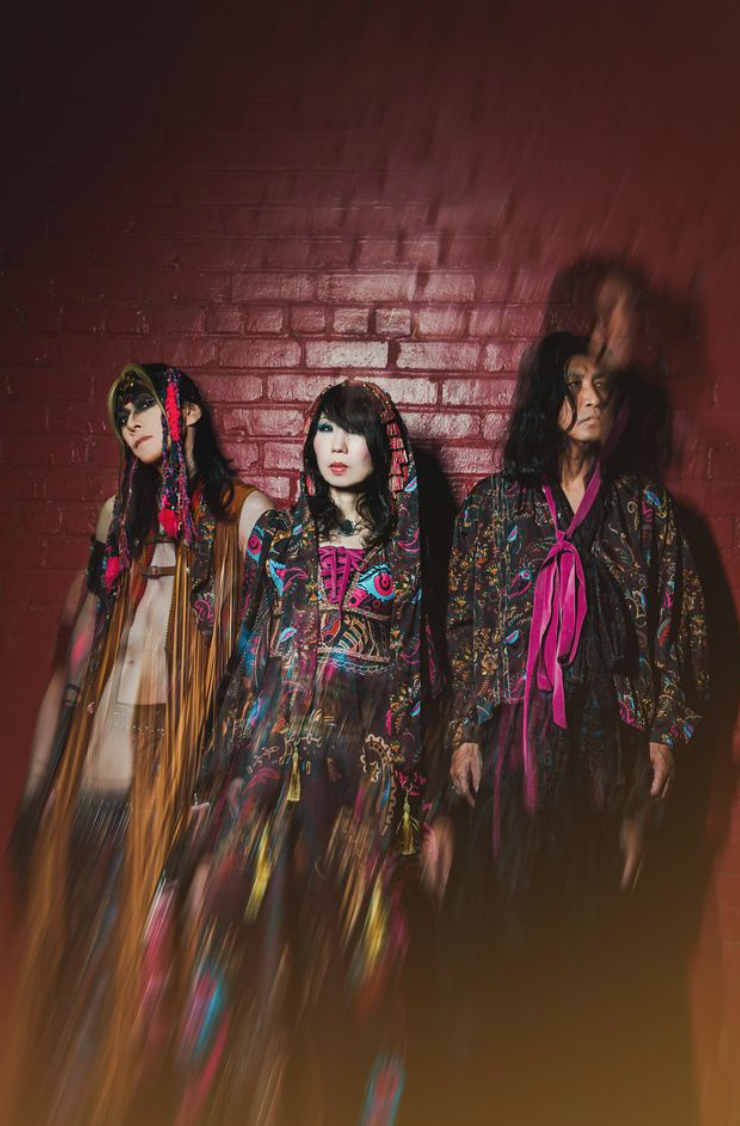
In the mid-2000s, the Western doom, sludge and heavy metal scenes were characterised by a hyper-masculine, aggressive aesthetic. Think black album covers, skulls, morbid imagery and a 'tough guy' posture. Meanwhile, Boris completely subverted this visual and sonic language. The band released a guitar record that was incredibly heavy, and they wrapped it in bright pink packaging. They named it Pink, and they took inspiration from Japanese kawaii culture. This created a brilliant, perhaps unintentional, filter. Suddenly, even regular indie-rock fans, shoegaze kids and art-school crowds, who might otherwise have stayed outside the heavy music tent, were pulled into this world, too.
This year, Boris have taken Pink back on the road for its 20th anniversary with the Do You Remember The Pink Days? world tour. They had not planned to revisit the album after its 10th anniversary, but the growing number of younger listeners at their shows gave them a reason to return to that era. Ahead of their UK and European dates, I wanted to talk to the band about Pink and the band's legacy. Boris have done endless interviews over the years, in which they have been asked to explain everything from their studio setup and break down their discography. But given the perspective they’ve built over nearly 35 years, I was far more interested in their take on our current reality.
What happens when technology runs out of control? What does DIY mean when underground platforms are steadily monetized, and how do we navigate a world ruled by algorithms? What is the value of physical struggle in art today? I chatted with Takeshi about all of this and found that, despite decades of deafening decibels, their stance remains clear: for Boris, the word 'heavy' is synonymous with a sound that is real.
The pleasure that lies just beyond suffering can only be reached through an intense, shared exchange of time between yourself and others right there in that space. AI will probably never ask itself what it feels like to say, "I was right there."
You named your current tour 'Do You Remember The Pink Days?. In bringing Pink back to the stage twenty years later, what role does preserving the past play compared to reconstructing the songs through your current selves?
The major theme of this world tour is the 20th anniversary of the album Pink. Honestly, since we already did a tour featuring songs from the album for its 10th anniversary, we hadn't planned on doing a tour for the 20th. However, ever since the pandemic, a lot of younger audiences have been coming out to our shows. Since they likely didn't experience us twenty years ago, we decided to try putting together a tour with that era's setlist. Albums like Mabuta no Ura and Dronevil were also released the same year as Pink, so I'm hoping that by including tracks from them in the setlist, people can also feel the atmosphere of that time.
How to newly construct—rather than merely "re-create"—this "Pink Days" set using our current physical and mental states, alongside twenty years of musical experience, is a challenge in its own way. But touring through Canada, North America, South Korea, Australia, and Southeast Asia, I've really felt how warmly Pink has been embraced by so many young listeners, and I am certain that this album has truly taken its place in rock history.
“Pink" is a remarkably gentle title for such a heavy record. What did that colour mean to you back in 2005, and has that meaning changed after living with it for two decades?
When we're deciding on an album title, we talk it over among the members, and Boris albums always have a key colour. Back then, I felt like the colour pink was appearing a lot more in everyday life, and it caught my attention. Why does the colour pink captivate people? It has truly diverse nuances—it can give a very pop impression, a sexy impression, a toxic or vicious impression; it's a mysterious colour with so many varied meanings. As the songs for the album came together, pink naturally tied in as the key colour. I think it's precisely because pink is such an elusive, unquantifiable colour that so many people became interested in Boris and became fans. As I've been realising on this current tour, even twenty years later, it's still an album full of mysteries. I don't even know myself how we managed to create songs like that.
Is there anything on Pink that you would make differently today—not because you think it was wrong, but because twenty years of experience have changed your understanding of sound, performance, or songwriting?
As for the studio recordings, there isn't really anything I'd want to change. After all, an album is like a documentary of us at that specific time. When it comes to live shows, we update our sets based on the experience we've accumulated since then and the evolution of our gear.
If you could place one sentence beside the album for someone discovering it for the first time in 2026, what would you want them to know before they press play?
Play it at full volume! If possible, take off your earbuds or headphones and crank up the speakers so much that the room shakes!
If you strip away all the reviews, the genre labels, and the twenty years of hype—when the three of you sit down and listen to Pink today, what do you personally hear?
As I mentioned earlier, it's truly an album full of mysteries, even to me. I don't know what it is that shakes so many people's ears and hearts, and my memories of how the songs even came together are hazy. To talk a bit about myself, up until the release of Pink, I was working a permanent job while playing in the band. I'd be busy working during the day, and right after finishing, I'd head straight to the studio to jam and record endlessly. I'd even jot down lyrics that popped into my head while on the job. I was making Pink right in the middle of that dizzying daily routine. Right after the release, we started going on long tours, so I quit my steady job and began living solely off music. Back then, everything in my life was changing at breakneck speed, so maybe that kind of tension and impatience shows up in the sound. It's still just as fun to play today.

Boris relies on sweat, analog gear, and human stamina. Now that AI can generate "heavy" music instantly and without friction, what is the value of physical struggle in art today?
I suppose it's the realisation of "I was right there." Back in the day, there was a period when we would haul massive amounts of gear night after night into tiny basement clubs to play shows. A fan once told us, "My eyeballs were shaking the entire time Boris was playing," and we had audience members back-to-back suffering physical and mental distress from the sheer vibration and volume. Even as performers, we could feel our skin vibrating from the amp volume. In other words, these are things you can only experience in that exact moment—a roaring wall of sound and lighting that makes you lose your sense of balance, the scent of heavy smoke so thick you can't see your own feet, and so on. The pleasure that lies just beyond suffering can only be reached through an intense, shared exchange of time between yourself and others right there in that space. AI will probably never ask itself what it feels like to say, "I was right there." Nor does it need to.
You came of age in a musical culture built around physical objects, local scenes, and human relationships. But today’s generation discovers music through algorithms that predict what they will like. Do you think an algorithm can ever lead someone to music that genuinely changes them?
When listening on streaming services, recommendations sometimes introduce you to music you didn't know you liked. Back in the day, our musical tastes expanded through recommendations from friends or record store clerks, or by digging deep and researching music on our own. That kind of knowledge is now reflected in algorithms, making it a convenient world. I suppose that translates the love of music held by so many people. But if people stop pouring their own unique love into music and start relying solely on algorithms built on past memories, I feel like the story leading up to encountering music becomes a bit bland and watered down. I really believe this world can be made even richer through music.
Records like Flood and Absolutego ask the listener to completely surrender and be patient. In an era where the internet has trained everyone to have a 15-second attention span, how do you feel the bond between the band and the audience has changed?
I think there's an increasing amount of music out there being judged purely on a momentary basis. Our role is to sublimate the richness of music, as we see it, into our own art and keep creating. We want to present gateways to that richness so they can be viewed from as many angles as possible. At least among our fans, many are wide-ranging music enthusiasts—what you'd call "discerning listeners"—so I think they well understand the relationship between music and time: that crucial process where sound changes and amplifies along a timelin
Western commentary often frames Japan through dualities—hyper-technology alongside tradition, extreme consumerism alongside minimalism, kawaii culture alongside harsh noise. Do you feel Boris was genuinely shaped by these cultural tensions, or is that just an outside perspective projected onto you?
Our generation went through the dawn and peak of subculture in Japan, so in a sense, I can understand why we might be viewed in the way you mentioned. In fact, Pink was also influenced by the era when Japanese kawaii culture was on the rise, and by the sea of pink that was appearing everywhere back then.
The music industry has become good at turning rebellion into a marketable aesthetic. Even noise, punk, and underground music can now be packaged into playlists and recommendation categories. What can an artist still do that the market cannot easily commodify?
We've now been active for a long span of thirty years, and we're not conscious of the market at all. Originally, we never had any desire to sell records or score big hits. Right now, as a lifelong work, we're turning our own unique way of engaging with the world into our art. We're not just making music; we're living our lives. We are heading toward a more authentic form of expression.
With Fangs Anal Satan, you built your foundation on true self-reliance outside corporate music channels. Is a pure DIY mindset still possible today, when even underground platforms end up being bought or monetized?
I met the other members of Boris at art school. Making art and presentations on our own was just a completely natural thing for us from a young age. In the music scene, "DIY" is often treated as something precious or special, but to begin with, that's just how things should naturally be. There's a sort of misunderstanding or misdirection there—you can trace a narrative where we, having ended up making mere commodities, used DIY methods to return to who we really are and reclaim ourselves. Imagining, creating, and releasing things with our own hands has been a given for us from the very beginning. It's not about being swayed by the times or societal systems; it's simply our way of existing.
The internet has made music globally accessible, but it has also flattened context. A teenager in another country can discover Boris without knowing anything about Japanese hardcore, the Tokyo underground, or the records that shaped you. What do you think about that?
I believe our music itself is a crystallization of contexts, an intersection of various links. We continue creating with the stance that listening to our music in itself becomes a connection to all kinds of contexts. The fact that various homages are included in the titles and artwork of Boris works is one part of that. That's why even if someone encounters Boris with zero prior knowledge, it's possible for them to access our music, our history, and the social and cultural backgrounds surrounding them in a multifaceted and open-ended way. I imagine the new generation will also generate brand-new values from those connections.
Boris moves between punishing volume and delicate beauty—sometimes in the same track. Do you view beauty and sonic violence as opposing forces?
The world always contains contradictory things. That is the real world. For us, the meaning of the word "heavy" is synonymous with "sound that is real."
Performing at extreme volume for over thirty years demands incredible physical devotion. Has your relationship with sheer loudness changed as you've matured, or does intense decibel overload still feel as vital as it did in 1992?
The fundamentals haven't changed at all. I feel that fans in various places come to our shows to experience the extraordinary and overwhelming power of high volume. Also, as I mentioned in the previous answer, silence is an important element as well. I hope we can share a world of real sound that rivals the forces of nature—grand landscapes, roaring thunder, and the rumbling ground—with everyone.
After Pink, international audiences suddenly felt like they "understood" who Boris was. Did becoming recognisable ever feel more dangerous for your creative freedom than being an obscure underground band?
Back when we actually released Pink, we were young and charging forward at our absolute maximum speed in search of new expression. There were times when we'd start working on the next new album without even releasing the one we'd just finished; we had our minds set solely on moving forward. We believed that art had no meaning unless it was new. But times have changed drastically between then and now. With the rise of AI and constant, unending wars in various places, it's an unstable era globally. Right now, it feels like artists are being called upon to play a different role. Rather than opposing the crises of the world with sheer novelty, we have to firmly present what we must carry forward from past history into the future. I think it's precisely because we've been active for over thirty years that I've come to realise this perspective.
Has your definition of "heaviness" changed over time? Is it still rooted in physical force—volume, distortion, and weight—or has it become something more emotional, psychological, or spiritual?
Ever since we started Boris, the form of "heaviness" we're chasing hasn't changed, and we still haven't reached its core. Both the overwhelming physical heaviness and the heaviness that appeals to the mind and psychology have always run parallel within us.
If your entire catalog vanished tomorrow and you could save just one single principle from over thirty years of making music, what core philosophy would you want to pass on?
I think there's already only a single fundamental principle left. All of our music is the same thing. I'm fine with letting whoever listens to it put that philosophy into words.
When you started in 1992, you couldn't have predicted streaming, algorithms, AI, or the social shifts of the past three decades. Looking at the world Boris has grown alongside, what is one thing about the future that concerns you, and what is one thing that still sparks your curiosity?
Whenever things or phenomena we couldn't predict appear, humanity has faced fear and concern over them since the dawn of history. I've always worried about what will happen if technology keeps running out of control like this. No, maybe it's not just a concern—perhaps the world has already ended. This grand self-indulgence called "band activity." Through the process of being heard and resonated with by various people, even that self-indulgence stops being just self-indulgence. The richness and hope we turn into sound are shared with the world. That's exactly why, more than ever, I want to travel to various countries—places and regions we've never been to before—and keep exchanging experiences with local fans and audiences. That is the most exciting thing of all. I still believe in the power of music and expression.


Comments